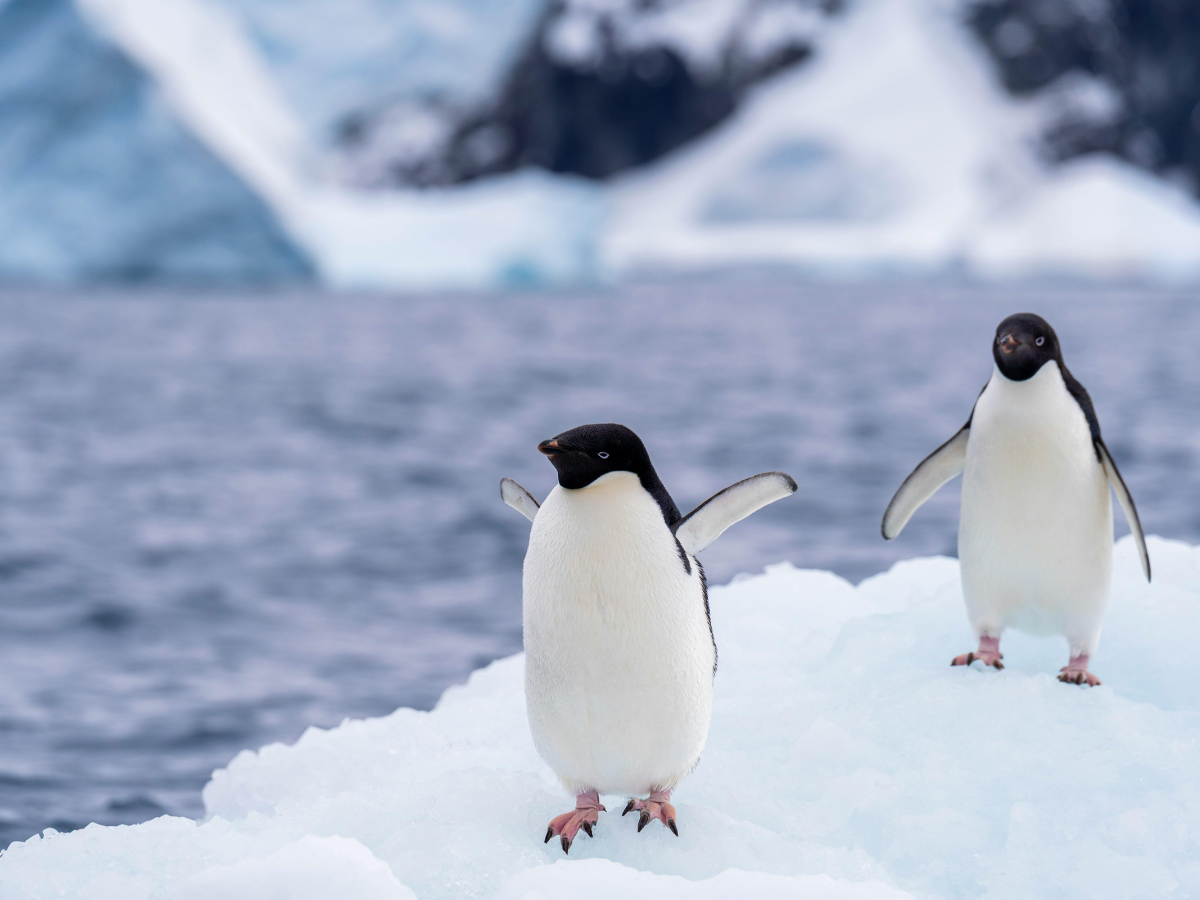
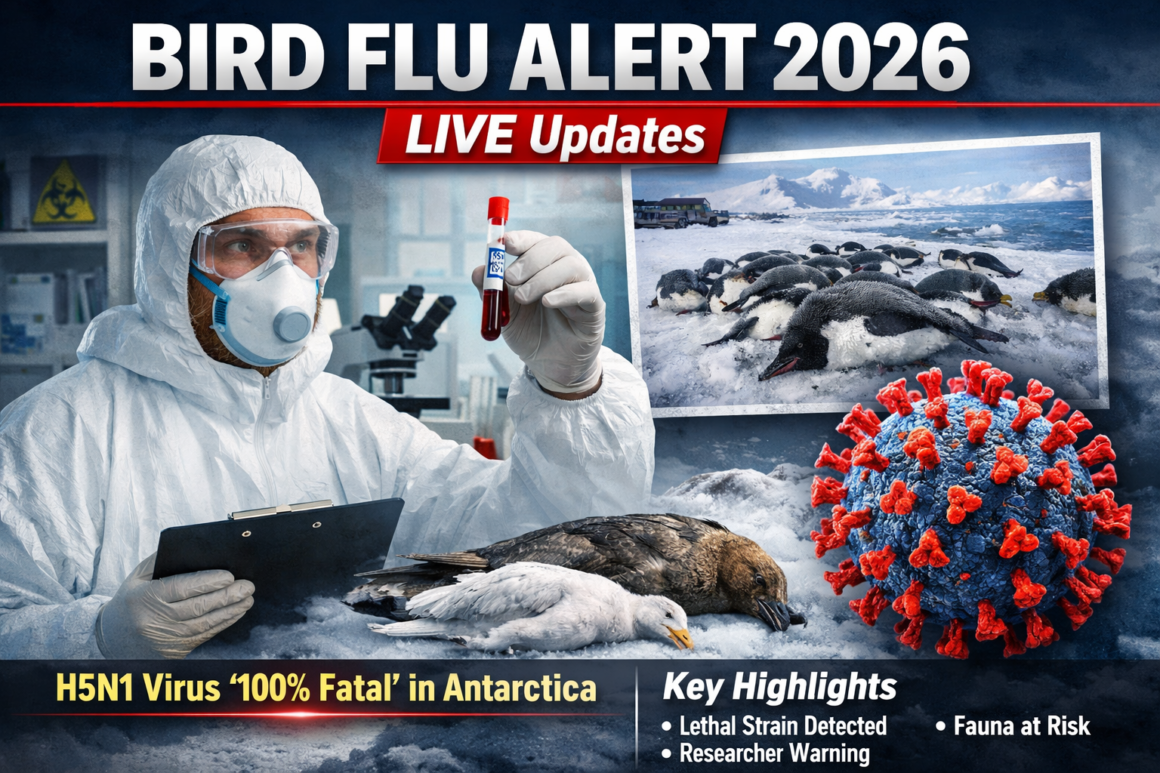
Scientists are warning over the spread of bird flu in Antarctica. A leading Chilean researcher, Victor Neira, on Tuesday told the media that a detected strain has the potential to “kill 100 per cent” of infected fauna. Though researchers have been warning about bird flu’s presence on the icy continent, which hosts temporary teams of scientists but no permanent residents, a particularly lethal strain was identified in April 2024 by Neira and his team in five skuas, a type of polar seabird.
“The virus has completely spread throughout the Antarctic region where we have the capacity to go and study,” said Neira, a scientist at the University of Chile and the Chilean Antarctic Institute (INACH).
Why Antarctica Is at Risk
Antarctica has long been considered one of the most ecologically isolated regions on Earth. However, migratory birds traveling between South America, Africa, and polar regions can act as carriers of avian influenza viruses. Researchers monitoring seabird colonies say the H5N1 strain currently circulating in parts of the world has shown unusually high mortality rates in wild birds and marine mammals.
The warning stems from observations that certain outbreaks in remote wildlife colonies have led to near-total die-offs of infected groups. In fragile Antarctic ecosystems — where species such as penguins, skuas, petrels, and seals breed in dense colonies — a fast-spreading virus could move rapidly through populations with little natural resistance.
What Is H5N1?
H5N1 is a highly pathogenic avian influenza virus first detected in the late 1990s. Over the years, it has caused outbreaks in poultry and wild birds across Asia, Europe, Africa, and the Americas. While primarily a bird virus, it has occasionally infected mammals, including foxes, sea lions, and other wildlife species.
The current concern centers on the virus’s evolving ability to infect a wider range of animals. Scientists note that the strain circulating in recent years has demonstrated increased adaptability in mammals compared to earlier variants.
READ MORE: Bird Flu Resurgence: Rising H5N1 Cases in Asia Raise Zoonotic Spillover Concerns
“100% Mortality” Warning — What It Means
The researcher’s statement about the virus being capable of killing “100% of infected fauna” refers to worst-case scenarios observed in isolated wildlife colonies where nearly all infected animals died. Experts caution that this does not mean the virus would wipe out all Antarctic wildlife universally, but rather that localized outbreaks could be catastrophic.
In tightly packed breeding grounds, where thousands of birds nest side by side, transmission can occur within hours. If the strain proves highly lethal and spreads unchecked, entire colonies could collapse within weeks.

Current Status in 2026
As of the latest updates, surveillance teams are conducting increased monitoring of migratory birds entering Antarctic territories. Biosecurity protocols for research stations have been tightened. Scientists and support staff are being instructed to disinfect boots, equipment, and clothing before and after field visits to prevent accidental spread.
READ MORE: Bird Flu Cure? Nasal Spray Vaccine Prevents Infection From H5N1: All You Need To Know
So far, confirmed large-scale outbreaks within mainland Antarctica remain limited, but neighboring regions have reported cases in seabirds. Authorities are treating the situation with urgency to prevent spillover into core breeding populations.
Risks to Humans
Public health experts emphasize that the current risk to the general human population remains low. While H5N1 can infect humans in rare cases — usually after close contact with infected birds — sustained human-to-human transmission has not been observed in this strain.
However, global health agencies continue to monitor genetic changes in the virus. Mutations that enhance mammalian transmission are of particular concern, prompting ongoing genomic sequencing efforts worldwide.
READ MORE: Bird Flu Is Evolving: Is H5N1 Becoming a Human Threat?
Conservation and Global Impact
The potential impact of a severe outbreak in Antarctica extends beyond regional wildlife loss. Antarctic species play vital roles in global marine ecosystems. Large-scale die-offs could disrupt food chains, affect predator-prey balance, and alter ecological dynamics for years.
Conservationists warn that climate change may further complicate the crisis. Warming temperatures and shifting migration routes can increase contact between species that previously had limited interaction, potentially accelerating viral spread.
What Happens Next?
Researchers are calling for coordinated international surveillance, rapid response teams, and transparent data sharing among nations operating in polar regions. The coming months will be critical as migratory cycles continue.
While the “100% mortality” phrase underscores the severity of potential localized outbreaks, scientists stress that preparedness, monitoring, and swift containment measures can significantly reduce risk.
For now, the world watches closely as Bird Flu Alert 2026 unfolds — a stark reminder of how infectious diseases can threaten even the planet’s most remote and seemingly untouched ecosystems.