

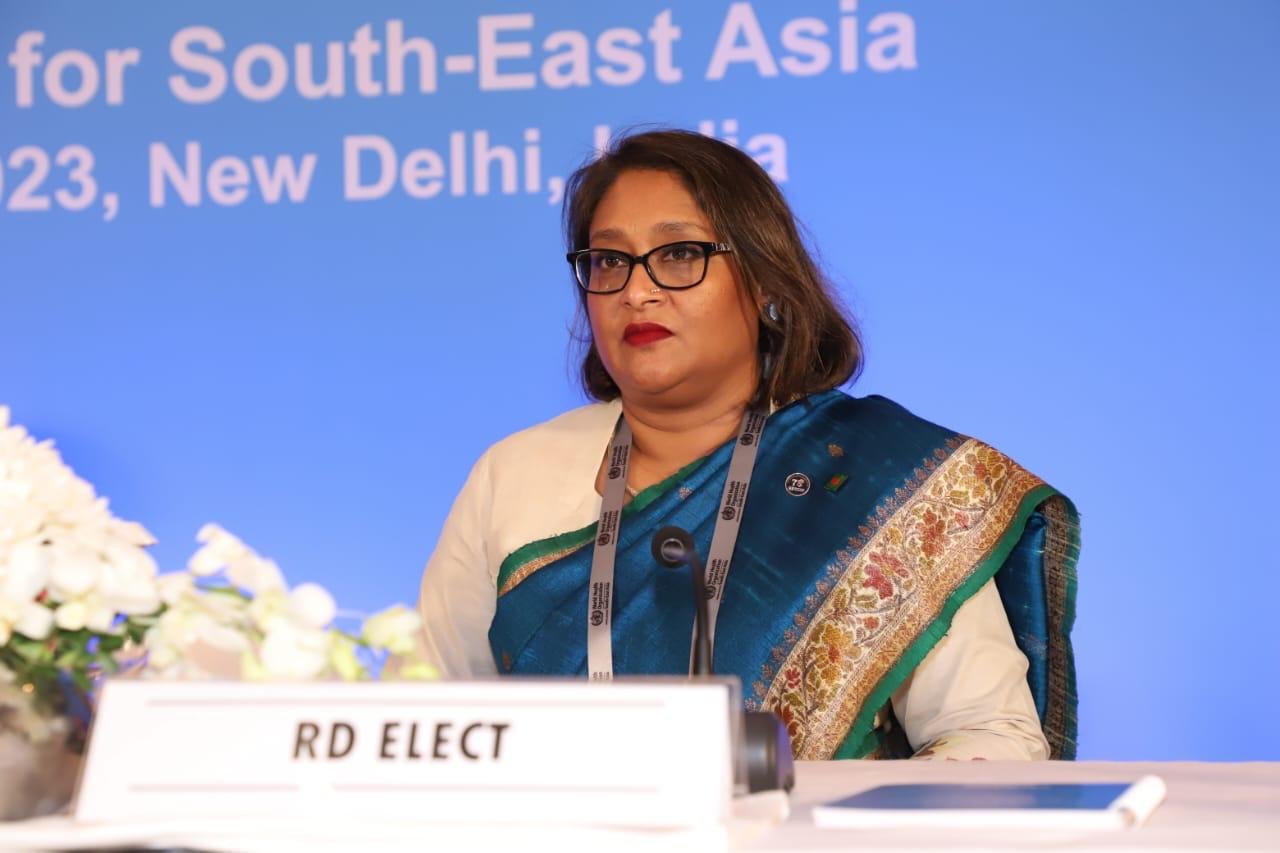
By Ms Saima Wazed, WHO Regional Director for South-East Asia
As we mark World Birth Defects Day 2024, WHO is highlighting the need to globally raise awareness about birth defects, and accelerate actions to prevent, detect and manage these congenital anomalies which occur during intra-uterine life.
We are reminded that “Every Journey Matters,” and the journey of health indeed begins before birth.
I am heartened that a regional implementation guidance on universal newborn screening of three conditions (hearing impairment, eye abnormalities, and neonatal hyperbilirubinaemia) is being released on this occasion to facilitate capacity-building of Member States.
Globally, the contribution of birth defects to the cause of death among under-5 children is unfortunately increasing. Between 2000 and 2021, the contribution of birth defects to child mortality increased in our WHO South-East Asia Region from 4% to 11%, and globally from 4.6% to 8%.
Birth defects are sadly now the third most common cause of death among under-5 children in our Region, accounting for 11% of the total. This is equivalent to the deaths of 300 under-5 children every single day.
Of our five Member States that have already achieved the SDG-3.2 target (under-5 mortality rate of 25 or less per 1000 live births), birth defects contribute to more than 20% of such deaths in four (DPR Korea, Maldives, Sri Lanka and Thailand).
Birth defects not only have a profound impact on individuals but also place a considerable burden on families, friends, the community and health-care systems.
While genetics plays a major role in their aetiology, many birth defects are preventable through addressing environmental factors. These include exposure to pollutants, lifestyle choices and socioeconomic conditions that affect pregnant women and fetuses.
Since 2014, WHO has supported all our Member States to drive rapid and sustained reductions in maternal, newborn and child mortality – which has included targeted action to prevent, detect, manage and care for birth defects.
An integrated approach has been adopted to implement interventions for the prevention and treatment of birth defects in existing national programmes.
Guided by the Regional Strategic Framework, all our Member States have national plans for prevention and control of birth defects.
The prevention, identification and management capacity of our Member States has been strengthened through the development of communication strategies, policy briefs, toolkits, manuals, and standard protocols contextualized to country needs.
The SEAR Newborn Birth Defects Database, a hospital-based online surveillance system for the early identification and tracking of birth defects, has to date recorded 4.6 million births – including 50,000 infants born with defects. Tertiary hospitals in Bangladesh, Bhutan, India, Maldives, Myanmar and Nepal have contributed to the database. While four other countries also have their own surveillance systems, data quality and coverage vary.
I’m pleased to say that routine childhood rubella vaccination has accelerated, with our region achieving an average coverage rate of 92% for the first dose. Furthermore, Bhutan, DPR Korea, Maldives, Sri Lanka and Timor-Leste have eliminated rubella, with no case of congenital rubella syndrome being reported.
Several Member States have introduced food fortification programmes, while pre-conception folic acid supplementation is being provided in all countries. Across our Region, pregnant women receive counselling to avoid potentially harmful medications, X-rays, tobacco products, alcohol and drugs.
While basic services for the management of birth defects are available in most countries, access to advanced treatments, rehabilitation and support is limited. Access to screening for birth defects also remains a challenge.
Accelerating prevention, management and care for birth defects is a priority, and we as a Region have issued a “call for action” in five key areas.
First, countries need to place birth defects high on their agenda and expand commitment and leadership at both the policy and programme level, along with commensurate financial allocations.
Second, the new regional document and videos on universal newborn screening of three conditions (hearing impairment, eye abnormalities & neonatal hyperbilirubinaemia) provide guidance on how simple bedside tests can be integrated within the existing health system. This is to enhance health system capacity for early detection and management of these conditions, and should be supported by effective systems for referral, diagnosis, management and follow-up.
Third, it is imperative to improve the coverage and quality of preventive interventions such as rubella immunization, food fortification and quality pre-conception and antenatal care. Aligned with the 76th World Health Assembly resolution WHA76.9 in 2023 on food fortification, our Member States need to plan, implement and monitor large-scale food fortification programmes.
Fourth, our Member States must work together with community-based networks, platforms and organizations, to recognize the challenges, hard work and perseverance of parents, caregivers and families of children with birth defects, and to empower them to access services and support, including social protection.
Finally, Member States must sustain and expand surveillance of birth defects, with a focus on improving coverage and quality of surveillance with regular data analysis and application. The results of data analysis must be used for mobilizing commitment and resources, along with improving programme implementation.
On World Birth Defects Day 2024, WHO reaffirms its commitment to accelerate actions to prevent, detect and manage these conditions – aligned with the “survive, thrive and transform” agenda of the Global Strategy for Women’s, Children’s and Adolescents’ Health (2016–2030).
Every journey matters.















Leave a comment