

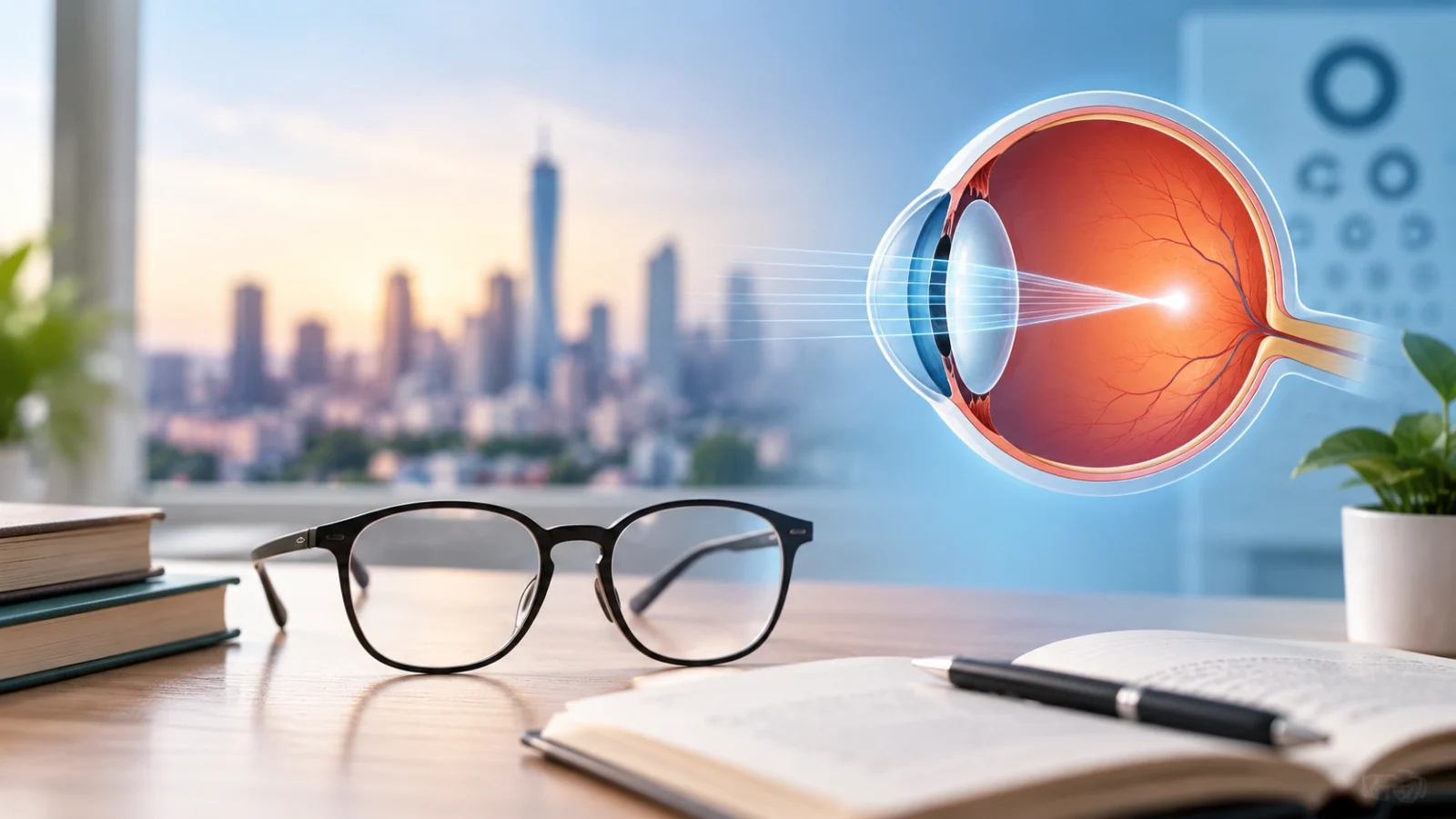
Myopia is a refractive error in which light entering the eye focuses in front of the retina instead of directly on it. This usually happens because the eyeball grows longer than normal or the cornea is too curved. As a result, distant objects appear blurred while nearby objects remain relatively clear.
In children, myopia often develops during the school years and may progress as the eyes continue to grow. A child may need stronger glasses over time, but frequent changes in prescription should not be dismissed as simply a need for new spectacles. They may indicate that myopia is progressing and needs closer monitoring.
What are the common signs of myopia in children?
Young children may not always realise that their distance vision is blurred. Parents may notice behavioural changes or signs that suggest a vision problem.
Some common signs include:
- Squinting or partially closing the eyes to see distant objects.
- Sitting very close to the television or holding books close to the face.
- Difficulty reading the classroom board.
- Complaining of headaches or eye strain after visual activities.
- Frequently rubbing the eyes.
- Blinking excessively or struggling to recognise people or objects at a distance.
- Moving closer to screens or objects to see them clearly.
These signs do not confirm myopia on their own. A comprehensive eye examination is needed to identify the cause of the symptoms and determine the correct prescription.
READ ALSO: Glaucoma Warning: Why This Silent Eye Disease Is Rising Rapidly in India
Why is early diagnosis of childhood myopia important?
Myopia that develops at a younger age has more time to progress while a child’s eyes are still growing. If the condition becomes severe, it can increase the lifetime risk of eye complications, including retinal detachment, glaucoma, cataracts and myopic maculopathy.
Early diagnosis gives an eye specialist an opportunity to assess the child’s vision, monitor changes in the prescription and discuss treatments that may slow the progression of myopia.
It is important to understand that spectacles correct blurred vision but do not necessarily stop the eyeball from growing longer. Myopia management therefore focuses on two goals: providing clear vision and slowing the progression of the condition wherever possible.
How is myopia managed in children?
Myopia management is not the same for every child. An ophthalmologist or trained eye-care professional considers the child’s age, current prescription, rate of progression, family history, eye health and ability to follow the recommended treatment.
Depending on the clinical assessment, the following options may be considered.
1. Prescription glasses
Regular prescription spectacles remain an important way to correct blurred distance vision in children with myopia. Children should wear the prescribed glasses as advised by their eye specialist.
Specialised myopia-control spectacle lenses are also available. Unlike conventional single-vision lenses, these are designed to correct vision while helping slow myopia progression. Their suitability depends on the child’s age, prescription and clinical requirements.
Parents should not reduce or change a child’s spectacle prescription without medical advice. Deliberately under-correcting myopia is not a recommended strategy for controlling its progression.
READ ALSO: Follow These Methods To Safeguard The Eye Health Everyday
2. Low-dose atropine eye drops
Low-dose atropine eye drops may be prescribed to slow the progression of myopia in selected children. Atropine is a medication that affects the eye’s focusing system, and studies have found that low concentrations can help reduce the rate at which myopia progresses.
The concentration, duration and frequency of treatment must be decided by an eye specialist. Children may experience side effects such as light sensitivity, pupil dilation or difficulty focusing on nearby objects, depending on the dose. Parents should never use atropine drops without a prescription or change the dosage on their own.
3. Specialised contact lenses
Certain contact lenses are designed to help manage myopia progression. These include multifocal soft contact lenses and other specially designed lenses that correct distance vision while influencing how light focuses within the eye.
Contact lenses require proper fitting, hygiene and regular monitoring. They may not be suitable for every child, particularly if the child is unable to follow safe lens-care practices.
4. Orthokeratology (Ortho-K)
Orthokeratology involves wearing specially designed rigid contact lenses overnight. These lenses temporarily reshape the cornea, allowing the child to see more clearly during the day without spectacles or contact lenses.
Ortho-K may also help slow myopia progression in some children. However, overnight contact lens use carries a risk of eye infection and requires strict hygiene, professional fitting and regular follow-up appointments.
The treatment should only be considered after discussing its benefits and risks with an eye specialist. The choice of treatment should be individualised. No single option is suitable for every child, and the availability of specialised lenses and treatments may vary.
Why are regular eye check-ups important for children with myopia?
A child’s spectacle prescription can change as the eyes grow. Regular eye examinations help the specialist determine whether myopia is stable or progressing and whether the current treatment is working.
During follow-up visits, the eye specialist may assess:
- Visual acuity: How clearly the child can see at different distances.
- Refractive error: The degree of myopia and any change in the spectacle prescription.
- Axial length: The length of the eyeball, where measurement is available. An increase in axial length can indicate progression.
- Overall eye health: The health of the retina and other structures of the eye.
- Treatment response: Whether the child is benefiting from the prescribed myopia-control approach and experiencing any side effects.
Children undergoing myopia-control treatment are often reviewed approximately every six months, although the schedule may vary depending on their age, rate of progression and treatment plan. Some children may need more frequent assessments.
Parents should not wait until a child complains of blurred vision or struggles at school before scheduling an examination.
Can lifestyle changes help slow myopia progression?
Lifestyle habits can support eye health and may help reduce the risk of developing myopia. However, they should not replace prescribed treatment for a child who already has the condition.
Parents can encourage the following habits:
Spend more time outdoors
Regular outdoor activity is associated with a lower risk of developing myopia in children. Aim to build outdoor play into the child’s daily routine. Children do not need to stare directly at the sun. Outdoor activities should be planned with appropriate sun protection and supervision.
Take breaks during reading and screen use
Long periods of uninterrupted near work may contribute to visual strain and are associated with myopia risk. Encourage children to take regular breaks while reading, studying or using digital devices. A commonly used approach is the 20-20-20 rule: after every 20 minutes of near work, look at something about 20 feet away for at least 20 seconds. This can help reduce eye strain, although it is not a treatment for myopia.
Maintain a comfortable reading distance
Encourage children to hold books and devices at a comfortable distance rather than bringing them very close to the face. Good lighting and a suitable study setup can also make reading more comfortable.
Balance screen time with physical activity
Screen use should be age-appropriate and balanced with outdoor play, physical activity, sleep and other daily activities. Simply reducing screen time does not guarantee that myopia will stop progressing, but avoiding prolonged, uninterrupted near work is a sensible habit.
READ ALSO: Glaucoma Risk Factors: These People Are More Likely to Develop the ‘Silent Vision Thief’
Does myopia go away as children grow older?
Myopia generally does not disappear as a child grows older. It often progresses during childhood and adolescence, although the rate of progression may slow as the eyes mature.
Glasses and contact lenses help correct blurred vision, while myopia-control treatments aim to slow further progression. These treatments do not usually reverse the underlying elongation of the eyeball. Even when a child’s prescription becomes stable, people with high myopia may need ongoing eye-health monitoring because of their increased risk of certain retinal and other eye complications.
When should parents take their child to an eye specialist?
Parents should arrange an eye examination if their child squints frequently, struggles to see the classroom board, sits unusually close to screens or complains of headaches or blurred distance vision.
A comprehensive examination is particularly important if one or both parents have myopia, as family history can increase a child’s risk. Children diagnosed with myopia should follow the review schedule recommended by their eye specialist, even if they seem comfortable with their current glasses. Sudden vision loss, a sudden increase in floaters or flashes of light, or a curtain-like shadow in the vision requires urgent medical assessment.
Childhood myopia needs more attention than simply changing a child’s spectacle prescription whenever vision becomes blurred. Early diagnosis, regular eye examinations and timely myopia-control treatment can help slow progression and support long-term eye health. Parents should watch for early warning signs, encourage outdoor activity and ensure that children follow the treatment and follow-up plan recommended by their eye specialist.
Follow HealthWireMedia.com for all the latest health news and developments from around the world.










Leave a comment