

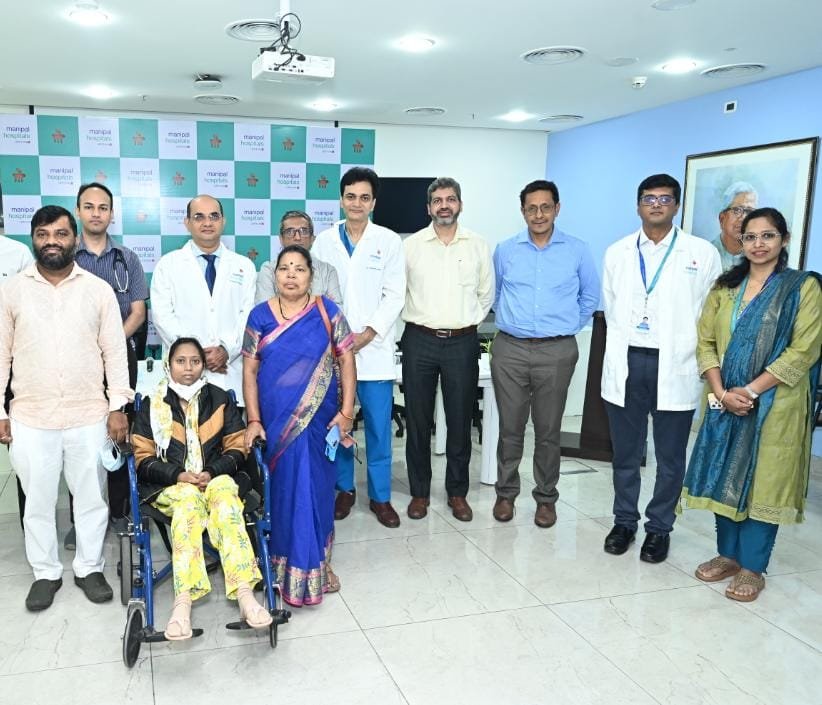
In a remarkable medical achievement, doctors at Manipal Hospital, Baner, Pune successfully performed a kidney transplant for a 40-year-old woman named Aarti Mashale, who had been suffering from kidney failure. The surgery was particularly challenging due to the differences in blood groups between Aarti and her donor husband, as well as the donor’s rare triple renal arteries.
Aarti Mashale, a homemaker, has been battling severe health issues since 2015. Her troubles began with a diagnosis of Systemic Lupus Erythematosus (SLE), an autoimmune disease that led to lupus nephritis, affecting her kidneys. Despite trying five different medications, Aarti’s severe hypertension could not be controlled. In 2020, her health took a further hit with the onset of herpes zoster and diabetes. By April 2021, Aarti showed early signs of kidney failure, which rapidly worsened, leading to the need for dialysis by 2023.
As her condition deteriorated, Aarti required an urgent kidney transplant. Her husband, Rahul Mashale, stepped forward to donate one of his kidneys. However, the transplant posed significant challenges due to ABO incompatibility, as Rahul had AB+ blood while Aarti had A+ blood. Additionally, it was discovered that Rahul had triple renal arteries, a rare condition seen in only 10% of the population.
Despite these challenges, the medical team, led by Dr. Tarun Jeloka and Dr. Anand Dharaskar, successfully performed the kidney transplant on July 18, 2024. The surgery was intricate because of the donor’s three renal arteries and the recipient’s single artery.
According to Dr. Anand Dharaskar, Consultant Urology at Manipal Hospital, Baner, Pune, “This was a challenging case for us. Performing a transplant was complicated as the donor had three renal arteries, while the recipient had only one. Suturing the three arteries was difficult in the donor’s case, therefore, we performed a laparoscopic surgery to harvest the kidney, which is less invasive, quicker to heal, and more cosmetically preferred for the donor. However, transplanting the kidney into the recipient with only one artery was equally daunting, requiring precise vascular reconstruction to ensure proper blood flow.”
The challenge of mismatched blood groups was also addressed with a special protocol. Dr. Tarun Jeloka, Consultant Nephrology and Transplant at Manipal Hospital, Baner, Pune, explained, “We performed the transplant using a special protocol for incompatible blood types. To reduce the risk of rejection, we gave the patient a monoclonal antibody medication two weeks before the transplant, followed by additional medications a week before. We also did a procedure called plasma exchange to remove harmful antibodies from the blood until they reached a safe level. Despite the higher risks, the transplant was successful, just like a matched transplant. The patient’s kidney function became normal within two days, and was able to go home without any complications.”
The success of the surgery was evident as both the donor and recipient recovered well. The donor, Rahul, was discharged within seven days, while Aarti was discharged within nine days of the procedure. The recovery period for both is expected to be similar to that of matched transplants: 2-4 weeks for donors and 6-12 weeks for recipients. Both Rahul and Aarti can look forward to living normal lives, although Aarti will need to take transplant medications for the rest of her life.
In India, 71% of kidney donors are female, with 90% of spousal transplants involving wives donating to their husbands. There is a common concern that kidney donation may affect the health of male breadwinners, but this case highlights that kidney donation does not compromise the donor’s health in any way. The doctors hope that this success story will inspire more men to come forward as donors, ensuring their loved ones receive the life-saving care they need.
















Leave a comment