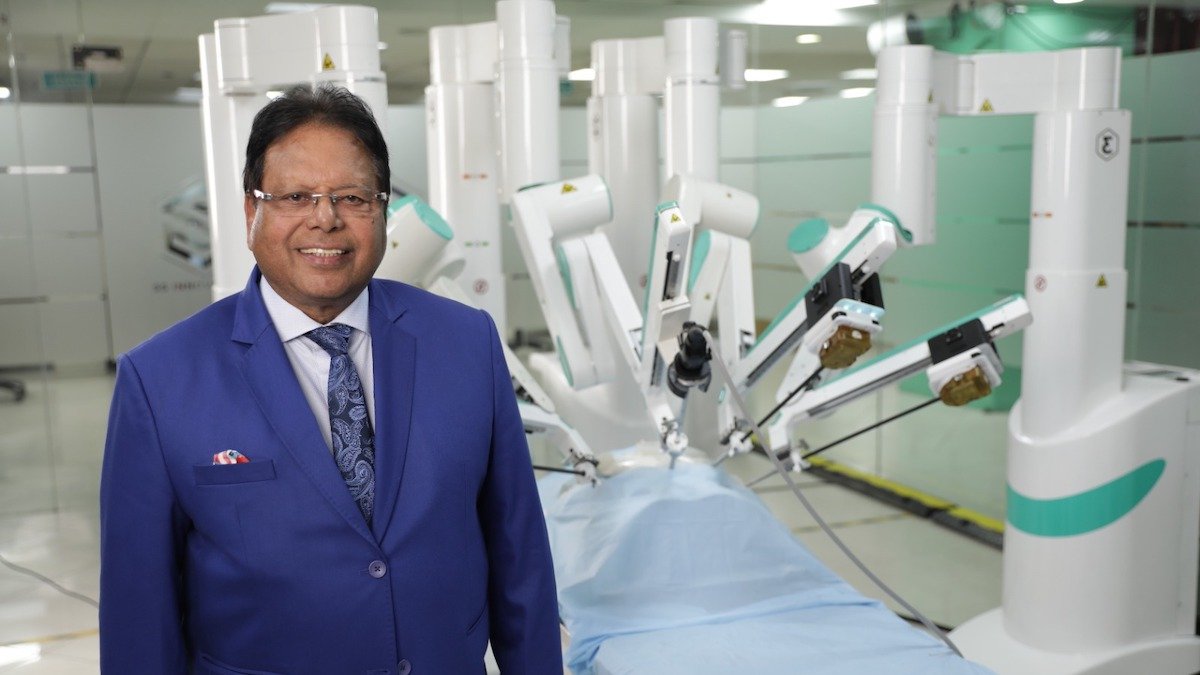
India’s latest breakthrough in robotic cardiac surgery has brought renewed attention to a surgeon whose work has been shaping the field for decades. Dr Sudhir Srivastava, Founder, Chairman and CEO of SS Innovations International, is behind the development of the SSI Mantra Surgical Robotic System, an indigenous platform now being used for increasingly complex minimally invasive procedures.
The successful completion of the world’s first dual-console, five-arm robotic beating-heart Totally Endoscopic Coronary Artery Bypass (TECAB) procedure at Medanta, Gurugram, on November 18, 2026, marks another important milestone in this journey.
Performed using the SSI Mantra system, the procedure brought together two surgeons operating through separate consoles, with all five robotic arms deployed simultaneously. The patient’s heart continued beating throughout the operation, without requiring a conventional heart-lung machine.
But the significance of this achievement extends beyond a single operation. It reflects the larger vision of Dr Srivastava, who spent years performing advanced robotic cardiac procedures internationally before returning to India to develop a surgical robotic platform that could address the high costs and limited accessibility of imported technologies.
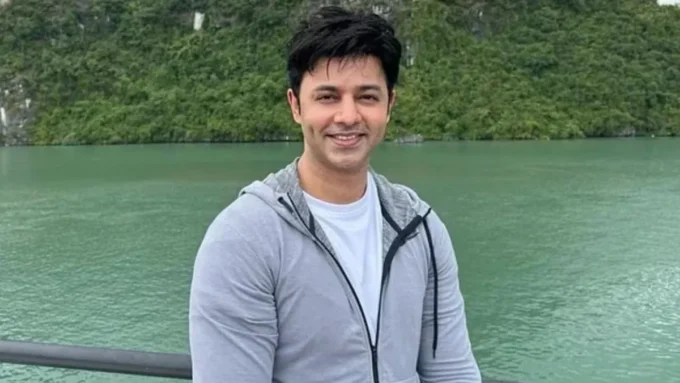
Who is Dr Sudhir Srivastava? The cardiac surgeon behind India’s robotic surgery ambitions
Dr Sudhir Prem Srivastava is a cardiothoracic surgeon and medical technology entrepreneur recognised for his contributions to robotic cardiac surgery.
Born in Rajasthan, he completed his medical education at Jawaharlal Nehru Medical College in Ajmer before moving to the United States in 1972 for further medical training. He subsequently completed his surgical training, including cardiothoracic surgery, at the University of British Columbia in Canada.
His career took him to the United States, where he became involved in developing minimally invasive and robot-assisted cardiac surgical techniques.
He established Alliance Hospital in West Texas in 2002, which developed into a major centre for robotic cardiac surgery. He later served at the University of Chicago, where he helped establish its robotic cardiac surgery programme, and founded the International College of Robotic Surgery in Atlanta.
During his career in the United States, he performed more than 1,400 robotic cardiothoracic procedures and trained over 350 surgical teams from different parts of the world, according to company disclosures.
His work included pioneering beating-heart TECAB procedures. He is associated with some of the earliest single-vessel, double-vessel and triple-vessel totally endoscopic coronary bypass procedures performed on a beating heart.
These experiences helped establish his interest in making complex cardiac surgery less invasive and expanding the role of robotics in the operating room.
Why did Dr Srivastava return to India to develop a surgical robot?
Despite establishing a successful career overseas, Dr Srivastava returned to India in 2011 with an ambition to expand robotic surgery in the country.
One of the challenges he recognised was the cost of robotic surgical systems. Advanced imported platforms required significant investment, making it difficult for many hospitals to adopt the technology and limiting access for patients who could potentially benefit from minimally invasive procedures.
A visit to India also proved influential. According to a profile published on the NITI Aayog Frontier Tech platform, Dr Srivastava encountered a young woman with a serious heart condition whose family could not afford the required treatment. The experience strengthened his resolve to develop a more affordable surgical technology platform.
In 2013, he began investing his own resources in the development of an indigenous surgical robot. He brought together engineers and medical technology specialists to work on the system, with the objective of reducing dependence on expensive imported robotic platforms.
The result was the SSI Mantra Surgical Robotic System, which was commercially introduced in 2022.
His journey represents an unusual transition from practising surgeon to medical technology innovator, combining clinical experience with engineering and product development.
SSI Mantra: The Made-in-India technology behind complex robotic procedures
Developed by SS Innovations, the SSI Mantra is a modular, multi-arm surgical robotic platform designed for minimally invasive procedures across several medical specialties.
The system supports three to five robotic arms and includes an open-faced surgeon command centre, a 3D 4K visualisation system and specialised surgical instruments.
Its applications extend beyond cardiac surgery to include urology, gynaecology, thoracic surgery, gastrointestinal procedures and head-and-neck surgery.
For cardiac procedures, the system can support technically demanding operations such as totally endoscopic coronary artery bypass grafting and other minimally invasive interventions.
The development of an indigenous robotic platform also addresses an important issue in India’s healthcare system: the need to expand access to advanced medical technology without making treatment prohibitively expensive.
The objective is not simply to manufacture a robotic surgical system in India but to develop technology that can be adapted to the needs of hospitals, surgeons and patients across different healthcare settings.
From robotic heart surgery to operating across 20,000 kilometres
Dr Srivastava’s work has also extended into one of the most ambitious applications of surgical robotics: telesurgery.
In June 2026, he performed a robotic cardiac procedure remotely from Georgetown, Guyana, on a patient located in Indore, Madhya Pradesh.
The procedure connected Georgetown Public Hospital Corporation in Guyana with IRCAD India in Indore through a fibre-optic communication network, covering a communication distance of nearly 20,000 kilometres.
Using the India-developed SSI Mantra system, Dr Srivastava remotely performed a Left Internal Mammary Artery (LIMA) takedown, an important surgical step in coronary artery bypass procedures.
The operation established a new benchmark for the longest-distance robotic cardiac telesurgery, surpassing the earlier reported distance of approximately 10,000 kilometres between Strasbourg in France and Indore in India.
The procedure used a remote surgeon console in Guyana, while the robotic arms and surgical instruments were positioned in Indore. The reported network latency was approximately 290–300 milliseconds.
This achievement demonstrated the potential of combining surgical robotics with high-speed communication networks to connect specialist surgeons with operating teams located thousands of kilometres away.
For countries with uneven distribution of specialised medical expertise, telesurgery could eventually create new possibilities for accessing advanced surgical skills. However, its wider adoption will depend on reliable connectivity, infrastructure, regulatory frameworks, trained local teams and robust patient-safety protocols.
Why the dual-console beating-heart surgery at Medanta is another major milestone
The November 18 procedure at Medanta brings another dimension to Dr Srivastava’s work in robotic cardiac surgery.
The operation was performed by Dr Nitin Kumar Rajput, Associate Director of Robotic and Minimally Invasive Cardiac Surgery at Medanta, Gurugram, and Dr Lalit Malik, Chief Cardiac Surgeon at Manipal Hospital, Jaipur, under Dr Srivastava’s supervision.
Unlike conventional robotic procedures involving a single operating surgeon at the console, the dual-console arrangement enabled two surgeons to participate in controlling the five robotic arms.
The approach is particularly relevant for complex beating-heart TECAB procedures, where surgeons must perform delicate movements on coronary blood vessels while the heart continues to beat.
It also offers a potential advantage for surgical training. A second surgeon can gain direct experience in robotic procedures by working alongside an experienced operator, rather than being restricted to assisting from the operating table.
For Dr Srivastava, whose career has involved both performing and training surgeons in robotic cardiac procedures, this development also reflects the importance of building expertise alongside technology.
Can India’s indigenous robotic technology change access to advanced surgery?
The development of the SSI Mantra system is part of a wider shift in India’s medical technology sector, where indigenous innovation is increasingly being explored as a way to improve access to advanced healthcare.
However, the success of robotic surgery cannot be measured by the number of systems manufactured or procedures performed alone. Patient outcomes, safety, surgeon training, long-term clinical evidence and the total cost of treatment remain essential considerations.
The SSI Mantra’s multicentre clinical experience, its use across different surgical specialties and its growing role in complex procedures provide an important foundation for assessing its potential.
The larger challenge will be ensuring that robotic surgery reaches beyond a limited number of major urban hospitals and becomes available to a wider population.
Dr Srivastava’s journey from a cardiac surgeon practising in the United States to an innovator developing surgical technology in India highlights the possibilities of combining medical expertise with indigenous engineering.
The world’s first reported dual-console, five-arm beating-heart TECAB procedure at Medanta is another chapter in that journey. Its long-term significance will depend on whether such technological advances can translate into consistently safe procedures, better patient experiences and wider access to advanced cardiac care.
For India’s medical technology industry, the achievement sends an important message: the country is not only adopting advanced surgical robotics but is also developing platforms that aim to compete on the global stage.