

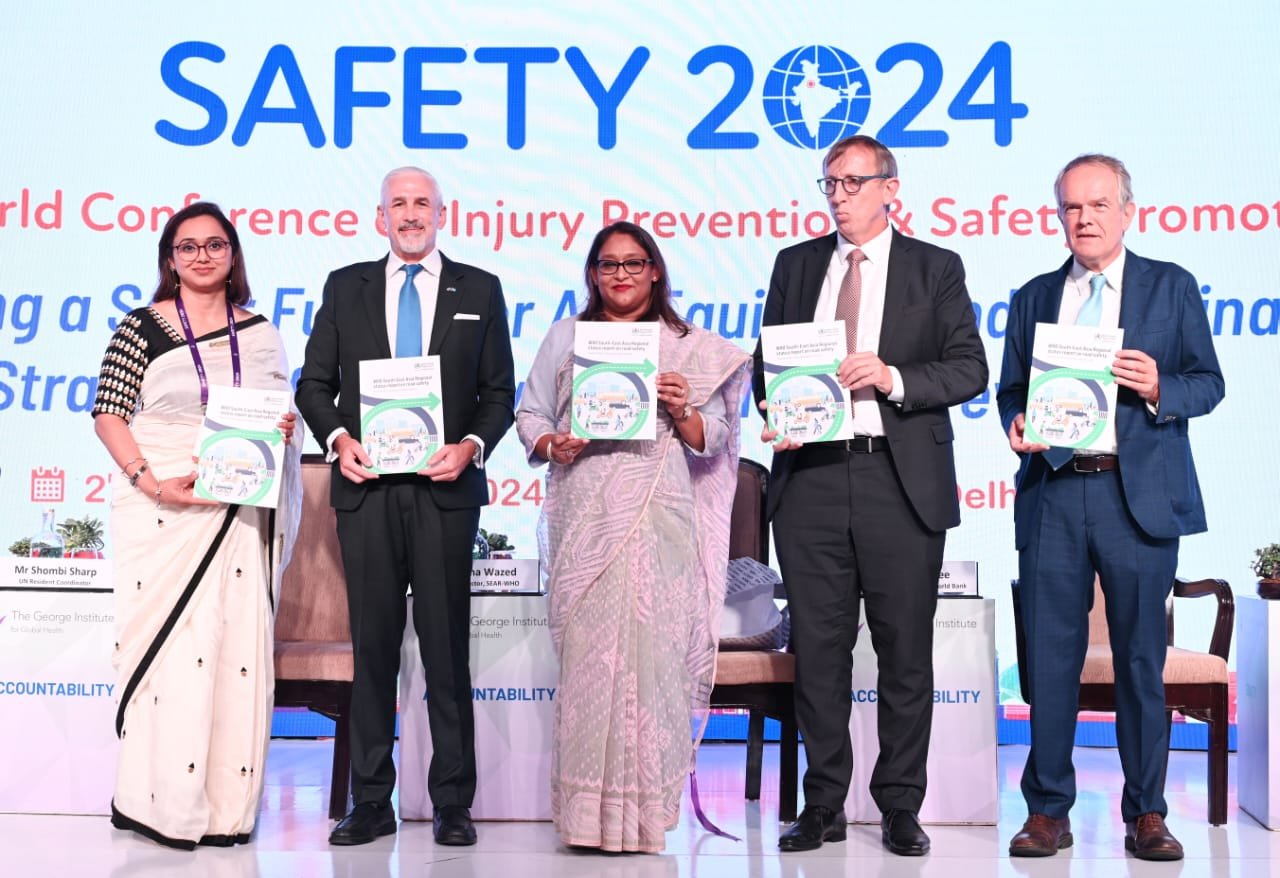
The World Health Organization today call on countries in the WHO South-East Asia Region to accelerate measures to reduce road traffic deaths. A leading cause of mortality among young people aged 15-29.
“Vulnerable road users, including pedestrians, bicyclists. And two or three-wheelers constitute 66% of all report road traffic deaths in our Region,” said Saima Wazed. Regional Director, WHO South-East Asia. in her address at the 15th World Conference on Injury Prevention and Safety Promotion (Safety 2024) which began here today.
She emphasize, “Our roads and road networks need to designed prioritizing those most at risk: children and adolescents. People with disabilities, pedestrians, and other vulnerable groups,”
The WHO South-East Asia Region account for 330 223 of the 1.19 million estimate global road traffic deaths in 2021, representing 28% of the global burden.
With 70% of the global population projected to live in urban areas by 2030, demand for public transport will surge. The WHO South-East Asia Region, amid rapid urbanization. Faces share challenges: a high prevalence of motorize two and three-wheelers. inadequate traffic injury data. Poor pedestrian and cyclist infrastructure, and limited emergency services.
Unlike High-Income Countries, where road safety measures often focus on car occupants. Low- and Middle-Income Countries need to prioritize the safety of vulnerable road users. Such as pedestrians, cyclists, and riders of two and three-wheelers who are disproportionately at higher risk.
Strengthening trauma and emergency care systems, enhancing road safety data. Strong leadership and promoting collaboration among all stakeholders are essential for improving road safety.
“I am a great believer in collaborations and partnerships – and expanding these to non-traditional stakeholders,” said the Regional Director. “This can be our moment to rethink and redo mobility for healthy cities. A holistic approach requires a cross-cutting, multi-sectoral approach. Requiring collaboration with local governments, urban planners, traffic policing, law enforcement, and others,” she added.
Road safety, a public health and development priority, is crucial to achieving the UN Sustainable Development Goals (SDGs). In September 2020, the UN General Assembly launched the Decade of Action for Road Safety 2021-2030 which aims to reduce road traffic deaths and injuries by at least 50% by 2030.
While the WHO South-East Asia Region saw a 2% decrease in road fatalities in 2021, contributing to a global 5% reduction. Further efforts are needed to meet global targets.
At the World Conference, the Regional Director launched the ‘WHO South-East Asia Regional Status Report on Road Safety: Towards Safer and Sustainable Mobility.’ “This report outlines Road Traffic Injury patterns in our countries and highlights best practices and country-specific interventions. It is both timely and essential for assessing our current position. And for guiding necessary actions to achieve global targets,” she stated.
Read Also – AIIMS National Eye Bank Celebrates 39th National Eye Donation Fortnight: Achievements and Future Vision
Addressing these challenges and implementing recommended strategies will be key to advancing road safety and reaching the 2030 targets. “Ensuring the safety of vulnerable groups enhances the safety of everyone in society. For example, when we design roads and pavements, buildings, and other physical infrastructure – if we make these accessible for persons with disabilities, we would have made them safer for everyone to use,” said the Regional Director.











Leave a comment