

Healthwire Bureau
New Delhi,24 January-The Director General of the World Health Organisation (WHO) Tedros Adnahom Ghebreyesus issued a statement on the outbreak of the deadly 2019 nCoV in China, which has claimed six lives so far and infected over 300 people, following urgent emergency meetings of International Health Regulations (IHR) at Geneva the last two days.
Here’s the full text of his statement:
“Good evening once again to everyone in the room, and to everyone online.
Once again, I’d like to thank Dr Didier Houssin, who has done a superb job of leading the Emergency Committee through what was a very complex deliberation. My thanks again to all the members of the committee for their time, expertise and full commitment.
I am not declaring a public health emergency of international concern today.
As it was yesterday, the Emergency Committee was divided over whether the outbreak of novel coronavirus represents a PHEIC or not.
Make no mistake. This is an emergency in China, but it has not yet become a global health emergency. It may yet become one.
WHO’s risk assessment is that the outbreak is a very high risk in China, and a high risk regionally and globally.
584 cases have now been reported to WHO, including 17 deaths. 575 of those cases and all of the deaths have been reported in China, with other cases reported in Japan, the Republic of Korea, Singapore, Thailand, the United States of America and Vietnam. We are aware of media reports of suspected cases in other countries, but those cases are still being investigated.
Let me talk about what we know.
We know that this virus can cause severe disease, and that it can kill, although for most people it causes milder symptoms.
We know that among those infected, one quarter of patients have experienced severe disease.
We know that most of those who have died had underlying health conditions such as hypertension, diabetes or cardiovascular disease that weakened their immune systems.
We know that there is human-to-human transmission in China, but for now it appears limited to family groups and health workers caring for infected patients.
At this time, there is no evidence of human-to-human transmission outside China, but that doesn’t mean it won’t happen.
There is still a lot we don’t know. We don’t know the source of this virus, we don’t understand how easily it spreads, and we don’t fully understand its clinical features or severity.
WHO is working with our partners night and day in China and the other affected countries, at the regional level and here at headquarters to fill the gaps in our knowledge as quickly as possible.
It is likely that we will see more cases in other parts of China and other countries.
China has taken measures it believes appropriate to contain the spread of coronavirus in Wuhan and other cities.
We hope that they will be both effective and short in their duration.
For the moment, WHO does not recommend any broader restrictions on travel or trade.
We recommend exit screening at airports as part of a comprehensive set of containment measures.
All countries should have in place measures to detect cases of coronavirus, including at health facilities.
The committee has made several recommendations to prevent the further spread of the virus, which the Chair has described, and which I have accepted.
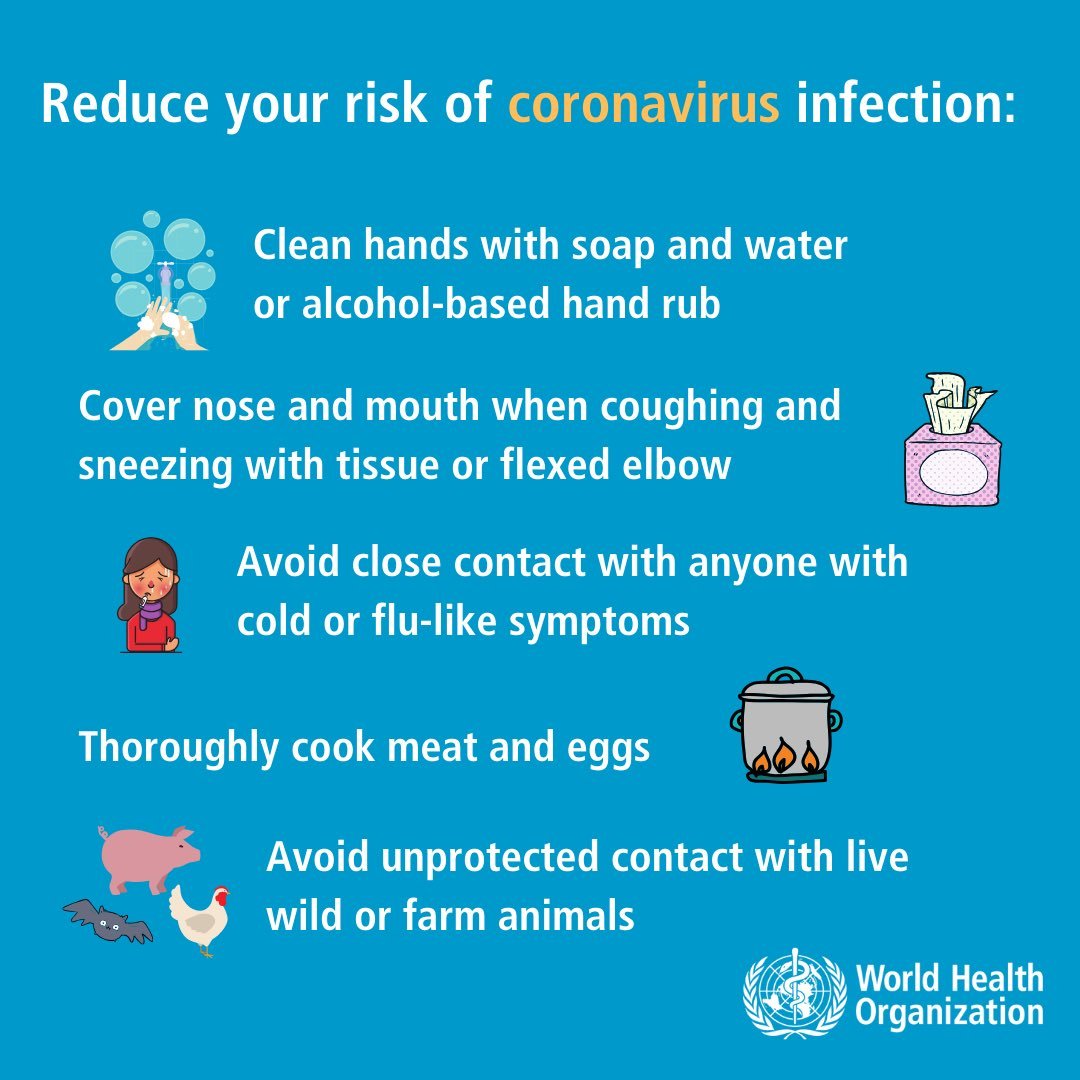
There are a few simple things we can all do to protect ourselves and each other, like washing hands, covering your mouth and nose when you sneeze, and so on.
WHO has a full package of information on its website.
Once again, I would like to thank the Government of the People’s Republic of China for its cooperation and transparency. The government has been successful in isolating and sequencing the virus very quickly, and has shared that genetic sequence with WHO and the international community.
This outbreak was detected because China had put in place a system specifically to pick up severe lower respiratory infections. It was that system that caught this event.
I wish to reiterate that the fact I am not declaring a PHEIC today should not be taken as a sign that WHO does not think the situation is serious, or that we are not taking it seriously.
Nothing could be further from the truth.
WHO is following this outbreak every minute of every day, at country, regional and global level.
We are working to prevent human-to-human transmission.
We have provided guidance to all countries for the rapid identification, management and containment of the virus.
We are coordinating our networks of global experts.
We are working to advance the development of diagnostics, therapeutics and vaccines.
We are completely committed to ending this outbreak as soon as possible.
And I will not hesitate to reconvene the committee at a moment’s notice – anytime. It could be in a day, it could be in a couple, it could be anytime.
Thank you very much.”













Leave a comment