

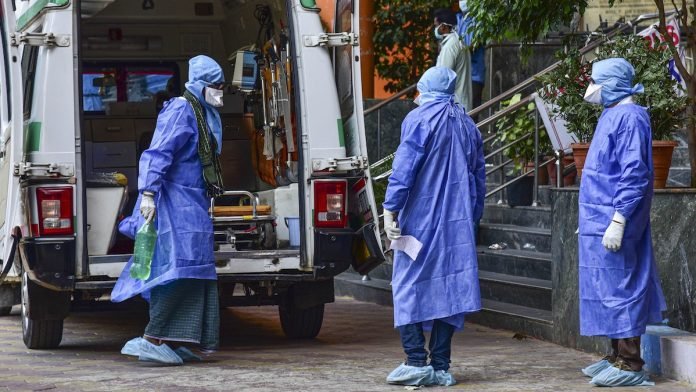
With 49,881 fresh Covid-19 cases, India’s total cases surged to 80,40,203 on Thursday, said the Union Ministry of Health and Family Welfare (MoHFW).
With 517 deaths in the last 24 hours, the toll has mounted to 1,20,527, according to the Union Health Ministery.
Total active cases stand at 6,03,687 after a decrease of 7,116 in the last 24 hours. Total cured cases stand at 73,15,989 with 56,480 new discharges in the last 24 hours.
India’s first Covid-19 case was reported on January 30 and the case tally reached one million on July 16 but it took just 13 days to go from three million to four million cases. India passed three million coronavirus disease cases on August 23 and crossed the four million mark on September 4. It has crossed the five million mark on 15 September and it took India 43 days to cross the 80 million mark.
#IndiaFightsCorona#Unite2FightCorona
Signifying a landmark achievement, India has registered continuous decline in the average daily new #COVID19 cases over the past 5 weeks. pic.twitter.com/0OEYLtT7GX
— Ministry of Health (@MoHFW_INDIA) October 28, 2020
Union Health Ministry said India continues to be among the countries with the lowest per million cases and per million deaths.
“With focussed strategy and proactive as well as calibrated measures of the Union Government along with the States and UTs, India has sustained its global position of being the country with one of the lowest cases per million population and deaths per million population,” it said.
#COVID19India updates
✅India continues to be among the countries with lowest per million cases & per million deaths, and high testing
✅Deaths per million populations in India are 87, substantially lower than the world average of 148
Read more: https://t.co/XMgYIpQLyx pic.twitter.com/EDyMNeb5N5
— PIB India (@PIB_India) October 28, 2020
Maharashtra continues to be the worst-hit state by the virus with 6,738 new Covid-19 cases, 8,430 recoveries, and 91 deaths. The Covid-19 tally of the state rose to 16,60,766, with 14,86,926 recoveries and 43,554 deaths while the active cases are at 1,29,746.
A total of 8,790 fresh Covid-19 cases and 7,660 recoveries were reported in Kerala today. 94 healthcare workers among those infected. The covid-19 death toll in the state stood at 1,403.
Meanwhile, the spread of the novel coronavirus in Delhi has quickened in the last few days with new infections are rising rapidly. Delhi”s daily coronavirus infection tally crossed the 5,000-mark for the first time on Wednesday as the national capital witnessed a sudden spike in cases in the past few days.
According to a health department bulletin, the national capital recorded 5,673 fresh Covid-19 cases, the highest single-day spike here to date, taking the total caseload to over 3.7 lakh. The previous highest single-day spike of 4,853 cases was recorded on Tuesday.
In the last 24 hours, 58% of the new deaths have been reported in 5 States/UTs.
Maharashtra has reported the maximum number of deaths in a single day (84 deaths): Secretary, @MoHFW_INDIA
#Unite2FightCorona #StaySafe pic.twitter.com/4UelDvrHWH— PIB India (@PIB_India) October 27, 2020
Tamil Nadu reported 2,516 new Covid-19 cases, 35 deaths, and 3,859 discharges today, as per the State Health Department. The total number of cases in the state is now at 7,16,751 including 6,79,377 discharges and 11,018 deaths. There are 26,356 active cases in the State.
As many as 2,949 Covid-19 tests and 18 deaths were reported in Andhra Pradesh, taking the total number of cases to 8,14,774 in the state. In the past 24 hours, 3,609 persons were recovered.
A total of 5,673 cases and 40 deaths were reported in Delhi, taking the total number of cases in the national capital to 3,70,014. As many as 4,128 people have recovered today.
A total of 3,34,240 people have been cured so far in Delhi while the death toll reached 6,396.
Gujarat reported 980 fresh cases of Covid-19, 5 deaths, and 1,107 recoveries today. The state’s case tally stood at 1,70,053. The total number of cases includes 1,52,995 recoveries, 13,354 active cases, and 3,698 deaths now.
Punjab reported 528 new Covid-19 cases, 356 discharged cases, and 20 deaths, taking total positive cases to 1,32,263 to date, including 1,23,866 discharges, 4,239 active cases, and 4,158 deaths.
While, Manipur reported 205 new infections cases today, taking the total cases to 17,6809 out of which 4,233 are active cases. The total number of deaths stands at 156.
A total of 536 new Covid-19 cases were reported in Jammu and Kashmir today; 199 from Jammu division and 337 from Kashmir division. A total number of cases now at 93,213 including 6,976 active cases, 84,782 recoveries, and 1,455 deaths, Jammu and Kashmir administration said.
One person died in Mizoram due to a virus while 5 new recoveries were reported today. The total number of positive cases is 2,607 now, including 368 active cases and 2,238 recoveries.
Rajasthan detected 1,785 new Covid-19 cases and 10 deaths today. Total positive cases in the state stand at 1,91,629 including 1,877 deaths, 1,74,044 recoveries and 15,708 active cases.
Meanwhile, Union Minister Harsh Vardhan held a meeting through video conferencing to review Covid-19 preparedness and measures for ensuring Covid Appropriate Behaviour with Dr. C. Vijayabaskar, Health and Medical Education Minister, Tamil Nadu, and other senior officials of the State Government.
“The coming long festive season poses a significant risk that may threaten the improvements made against Covid-19 so far. We should all be vigilant for the next three months. Following simple Covid appropriate behavior will be effective in cutting the transmission of Corona. Prime Minister’s message of wearing a mask/face cover, maintaining a physical distance and frequent handwashing should reach the last citizen”, he said.










Leave a comment