

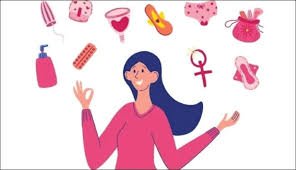
Menstrual Hygiene and menstrual health are a multifaceted term; simply supplying sanitary pads or napkins does not address the menstrual hygiene issue. It also includes right disposal of menstrual hygiene waste, quality products, managing health-related issues with proper guidance, easy access to menstrual hygiene hardware, making workplace gender friendly, sharing menstrual hygiene education right from menarche time to menopause, throughout the menstrual cycle approx. 3000 days of periods days, issues are different at each age group.
Educational interventions will improve understanding of menstruation among schoolgirls. Integrating menstrual-related conversations around young students can build a comfortable atmosphere in which peers give improved social support to one another. Menstrual hygiene management is made easier when menstrual hygiene devices are installed in public restrooms, workplaces, trains, airplanes, railway stations, and public restrooms, among other locations. The distribution of affordable menstrual absorbent can be facilitated by Anganwari asha workers and civil society organizations, as well as by common service centers, Anganwari centers, ration shops, self-help groups/lakhpati didi, panchayat ghars, and awareness workshops. Menstrual hygiene knowledge is equally crucial for boys; it has been shown that guys bully females on this issue; therefore, it is necessary to involve the male fraternity as well.
Raising Awareness at Ground Zero:
Teachers are one of the main sources of information for girls in schools. However, it has been observed that teachers aren’t fully aware of how to address every aspect associated with menstrual hygiene. Thus, all educational institution, Anganwari workers, Pradhans, and health workers must undergo training modules and guidelines in regional languages. This will ensure that the right information is communicated in an appropriate setting. Consistent awareness campaigns, workshops, and educational institutions, both formal and informal, are essential tools for breaking taboos and myths and promoting candid conversations about menstruation.
It has been observed that free distribution of sanitary napkins is ineffective in terms of absorbency, with girls changing pads every two hours. Access to high-quality pads at a low cost is still essential; certain civil society organizations undertake distribution drives, but they are all short-term. The government is responsible for distributing high-quality pads in schools. Administrators at schools should organize resources to establish sanitary napkin vending machines and give pads through social marketing campaigns.
Period – The Cultural Dilemma:
The longer we delay menstrual hygiene awareness for girls, the more they will suffer. Timely menstrual health and hygiene education is critical because uninformed women/girls view their periods with shame. This further creates a barrier in awareness and education, potentially having a negative impact on self-esteem and personal development. Menstrual hygiene awareness can be tailored to each segment of the population, and best practices can be disseminated across regions. Though social media, interactive videos, and posters, young females can be engaged. While panchayat ghars, anganwari/icds centers, and NGOs can serve as focal points for awareness, an incentive-based model has to be introduced to expedite awareness along with social marketing of sanitary pads and other menstrual absorbents.
Interestingly, while the overall status of menstrual hygiene is improving, the menarche age is decreasing, therefore it is critical to educate girls as early as possible, preferably after class 5 or by the age of ten. In the current day and age, it is crucial to create practices that view menstruation in the positive light. This will largely ensure better care and concern for women during menstruation while improving the access to sanitary items, functional water supply in toilet and privacy in the process.
Menstruation and puberty is one of the most important phases of human life and it must be celebrated across culture.
By Ms Prachi Kaushik, Founder & Director, VYOMINI Social Enterprise















Leave a comment