Home Latest News Indraprastha Apollo Launches RADIXACT-X9, Next Generation Tomotherapy Treatment
Latest News

Indraprastha Apollo Launches RADIXACT-X9, Next Generation Tomotherapy Treatment

Share
Share

Healthwire Bureau

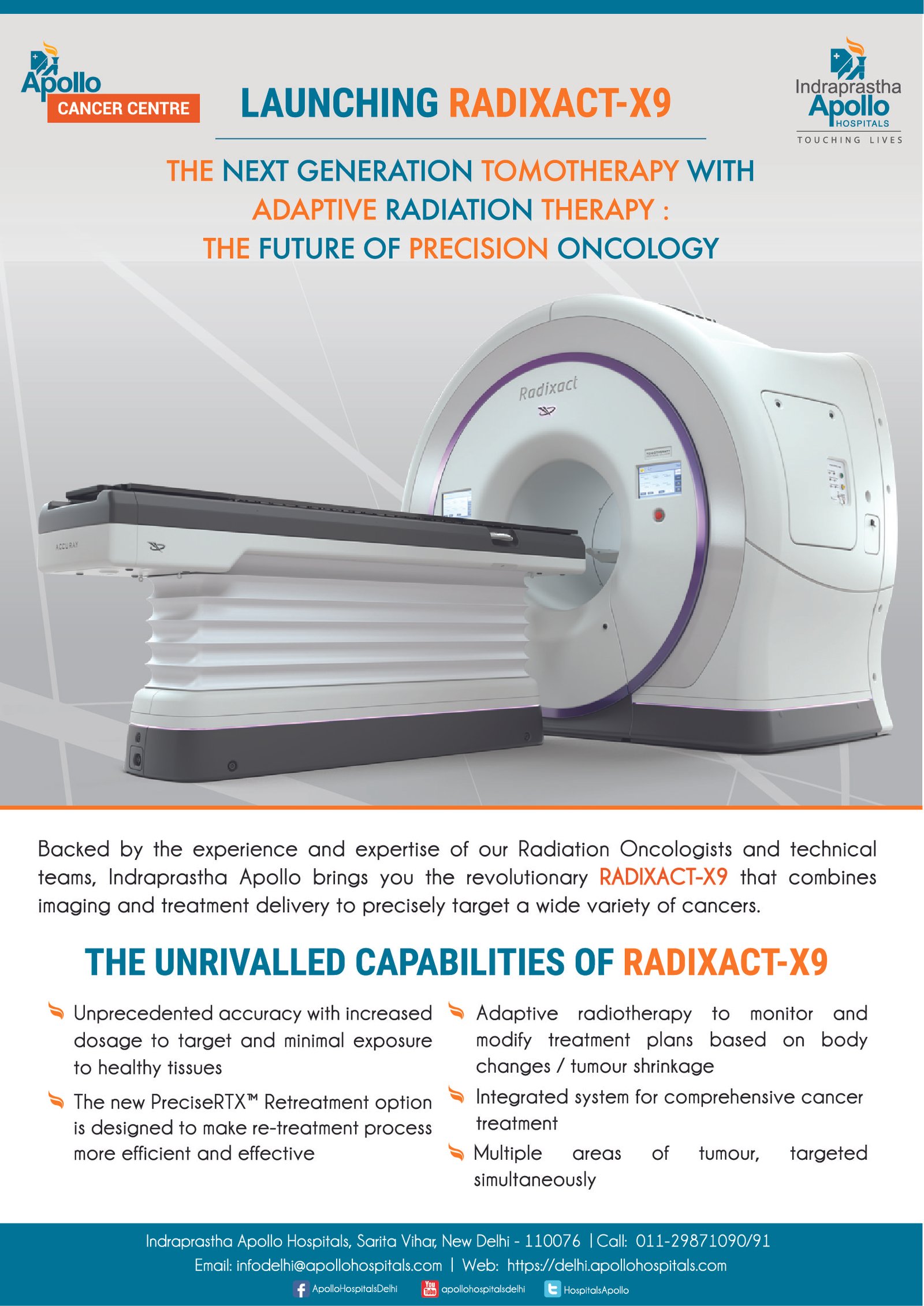
New Delhi, January 23-Indraprastha Apollo Hospitals has announced the launch of RADIXACT-X9, the state-of-the-art, advanced tomotherapy treatment machine with a cutting edge technology that combines imaging and treatment delivery to precisely target a wide variety of cancers.

Backed by experienced and expert team of radiation oncologists and technical teams, RADIXACT-X9, with its unrivalled calabilities, is the next generation Tomotherapy with Adaptive Radiation Therapy. The launch is hailed as the future of precision oncology.

What is Tomotherapy?

Tomotherapy is one of the most integrated, advanced Helical Radiotherapy machine for comprehensive cancer treatment. Radixact X9 Tomotherapy provides us with highly accurate and precise treatment targeting the tumour and sparing the nearby critical structures, thus minimising the side effects.

It is equipped with CT based Platform for image guidance of patient’s daily treatment. Because of its precision to the target, higher doses can be delivered achieving better cure rates and less side effects.

It has an inbuilt Adaptive Radiotherapy module which helps in dose monitoring and plan modification depending upon any change in anatomy or tumour regression. It is versatile to treat complex cases like Bilateral Breast, Total Body Irradiation, Total Marrow Irradiation and Stereotactic Body radiotherapy.

Tomotherapy has come as a boon to cancer patients. In short, Radixact X9 Tomotherapy is a machine of choice, capable of doing all high end treatments for cancer patients with better cure rates.

Revolutionary Features of RADIXACT-X9

-Unprecedented accuracy with increased dosage to target and minimal exposure to healthy tissues.

-The new precise RTX retreatment option is designed to make retreatment process more efficient and effective.

-Adaptive radiotherapy to monitor and modify treatment based on body changes/tumour shrinkage.

-Integrated system for comprehensive cancer treatment.

-Mutiple areas of tumour targeted simultaneously.

-Tomotherapy: The next generation therapy for cancer treatment

USES OF TOMOTHERAPY

Craniospinal irradiation: is a common treatment for children and adults alike and it’s a big challenge because of its large treating field. The image shows the treatment of the brain and spinal cord while minimizing doses to eyes, mouth, heart, kidneys and liver.

Lung Cancer: Treatment of tumour to only the selected lung tissue and avoid spinal cord and heart.

Bilateral Breast Cancer: Treatment of bilateral chest wall/breasts, internal mammary and other regional lymph nodes with minimal doses to heart and lungs.

Breast Cancer: treatment of breast tissue while avoiding heart and lung.

Head and Neck Cancer: High dose to tumour while limiting dose to spinal cord, brainstem and parotid (salivary) glands.

Prostate Cancer: High dose to the tumour and avoidance of rectum, bladder and femoral heads.

Stereotactic Body Radiotherapy (SBRT): Treatment of small tumours and metastatic lesions with high doses of radiation and daily image guidance enables effective tumour control and minimal side effects.

Cervical Cancer: Extended radiation therapy to treat pelvis and para-aortic lymph nodes with minimal dose to small bowel, bone marrow and other pelvic organs.

Total Marrow Irradiation: TMI wherein most of the viscera and critical organs are significantly spared and treating the whole bone marrow.

Share

Leave a comment

Leave a Reply

Your email address will not be published. Required fields are marked *

Don't Miss

Diabetes Day
Latest News

Diabetes During Pregnancy May Raise Infection Risk in Babies, New Study Warns

Pregnancy is a critical period not just for a mother’s health but also for the lifelong well-being of her child. New research is...

7 Simple Eye Exercises To Ease Screen-Induced Strain.
Lifestyle

Digital Eye Strain And Mental Fatigue: How Screen Overload Is Affecting Young Professionals

It this hyper-connected world, screens have become indispensable tools for work, communication, and entertainment. From laptops and tablets to smartphones and smart TVs,...

The Nipah virus is considered one of the deadliest zoonotic infections globally, not because it spreads rapidly like influenza or COVID-19, but because of its extremely high fatality rate, rapid progression, and severe brain involvement. Medical experts warn that once symptoms escalate, the disease can turn fatal within days. According to available data, the case fatality rate of Nipah virus ranges between 50 and 75 per cent, placing it among the most lethal viral infections known to humans. In this explainer, Dr Dip Narayan Mukherjee, Consultant – Microbiology and Infectious Diseases, CK Birla Hospitals, CMRI, sheds light on why the virus is so dangerous and difficult to control. Why Is the Nipah Virus So Deadly? According to Dr Mukherjee, Nipah’s lethality lies in a combination of delayed symptom recognition, aggressive disease progression, and early involvement of the brain. “Nipah virus often begins with very non-specific symptoms, which makes early detection difficult. By the time it is clinically suspected, the virus may have already affected the brain,” he explains. Early Symptoms Often Go Unnoticed One of the biggest challenges in controlling Nipah virus is that its initial symptoms closely resemble common viral illnesses, leading to delays in diagnosis and isolation. Early symptoms include: Fever Headache Cough Muscle pain General weakness “These symptoms are easily mistaken for flu, viral fever, or respiratory infections,” says Dr Mukherjee. “This delay gives the virus time to progress silently.” Severe Brain Infection Drives High Mortality The most dangerous aspect of Nipah virus infection is its neurological involvement. The virus frequently causes encephalitis, or inflammation of the brain, which significantly increases the risk of death. Neurological symptoms may include: Seizures Confusion and altered consciousness Extreme drowsiness Coma “Once the central nervous system is involved, the disease becomes very difficult to manage,” Dr Mukherjee notes. “At this stage, treatment is largely supportive because there is no specific antiviral therapy available.” This lack of targeted treatment options makes early detection critical. Human-to-Human Transmission Raises Risk While Nipah virus is primarily transmitted from fruit bats, it can also spread from person to person, particularly in healthcare settings. Dr Mukherjee points out that: Caregivers and healthcare workers are at higher risk Exposure to high viral loads can worsen outcomes Inadequate infection control increases transmission risk “Strict adherence to infection control practices is essential. Even a small lapse can result in secondary infections,” he says. Zoonotic Nature Makes Exposure Hard to Predict Nipah virus is transmitted from fruit bats, either directly or through intermediate hosts such as pigs. This zoonotic pattern makes outbreaks unpredictable, especially in regions where humans, animals, and wildlife interact closely. Adding to the challenge: There is no approved vaccine Treatment options remain limited Isolation protocols must be strictly enforced What Can Reduce Nipah Fatalities? According to experts, early action remains the most effective defence against Nipah virus. Key measures include: Early isolation of suspected cases Strict use of personal protective equipment (PPE) Rapid escalation and referral to specialised centres Strong hospital infection control protocols “The earlier the virus is identified and contained, the better the chances of preventing severe disease and fatalities,” Dr Mukherjee emphasises. The Bottom Line Nipah virus continues to be a serious public health threat because of its high fatality rate, neurological complications, and lack of targeted treatment. Its ability to masquerade as a mild illness in the early stages makes vigilance crucial. Health experts stress that awareness, early suspicion, and strict infection control are currently the most powerful tools to reduce deaths linked to this deadly virus. As Dr Mukherjee concludes, “With Nipah, time is the most critical factor. Early recognition can save lives.”
Latest News

Viral Outbreaks 2026: What Are Scientists Watching Out For?

As the world moves deeper into 2026, global health agencies and scientists remain on high alert for emerging and re-emerging viral threats. While...

heart disease
Case Study

Why the Fight Against Pediatric Heart Disease Starts Before Birth

Every heartbeat tells a story, but for thousands of infants in India, that story being interrupt before it truly begins. Despite the leap...

Parkinson's Disease
Latest News

Parkinson’s Disease: How the Interaction of Two Genes Triggers Neurodegeneration

Parkinson’s disease (PD) is one of the most common neurodegenerative disorders in the world, affecting millions of people and steadily increasing in prevalence...

Section title

Related Articles
Sleep Deprivation and Exams: Why All-Night Studying Is Hurting Student Health
Latest News

Sleep Deprivation and Exams: Why All-Night Studying Is Hurting Student Health

For many students, exams come with a familiar routine: late-night coffee, endless...

pregnancy covid
Latest NewsObstetrics & Gynecology

Fertility in Your 20s and 30s: Why Age Alone Doesn’t Guarantee Reproductive Health

For years, fertility has been closely linked with youth. Many people assume...

Measles Outbreak
Latest News

Measles Outbreak Surges Across the U.S. With Hundreds of New Cases Reported

A worrying resurgence of measles is unfolding across the United States, with...

×