


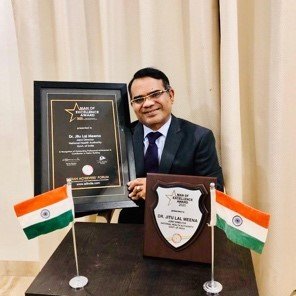
Dr. JL Meena is a Joint Director (JD) at the National Health, Authority – Ayushman Bharat – Pradhan Mantri Jan Arogya Yojana (AB PM-JAY) is working on special projects like—Hospital Networking and Quality Assurance. In an exclusive interview to Priyanka Sharma, Dr. Meena tells that his mother motivated him to work for quality healthcare in India. He aims is to provide quality and affordable healthcare service to all and improve the quality of healthcare service in India. He has been working for Quality in Healthcare service in the public healthcare sector since 2002. He was appointed as a State Quality Assurance Officer by the Government of Gujarat. Since then, his contribution to quality in the Healthcare system never stopped. His efforts on Quality in healthcare turned into a mass movement. Dr. Meena has received great appreciation from across the world and recently his article on the importance of quality in healthcare has been published in the latest issue of prestigious Oxford University.
Why did you thought to become a doctor?
It’s a complete emotional story. I hail from Sawai Madhopur in Rajasthan and belonged to a middle-class family. My father was a government servant and my mother was a homemaker. We were five brothers and I was the 2nd youngest child. I still remember that tragic day of my life when my brother who was in my final year of engineering contracted a fever and his health condition worsened. We rushed him to the hospital and doctors referred him to a district hospital for advanced treatment. When we took him to another hospital, my brother succumbed on the way. That day I thought to become a doctor.
What encouraged you to work for the quality in healthcare?
Way back in the 1996s, when I was in my early posting of MBBS, I had just started my practice in a private hospital. Meanwhile, my mother had fallen sick. I took her to senior doctors at a nearby hospital. Doctors had mentioned that it was just minor fever to my mother. I was satisfied that she would get well soon. But as days passed, my mother’s condition deteriorated and she got paralysed. As a doctor, I could understand that something was wrong. I took my mother to another doctor and he diagnosed my mother with cancer. But unfortunately, it was too late. Her condition become worsen by each passing day. I left my job just to take care of her. For six months, I was completely in her services. It was only due to my mother who taught me lesson for quality in healthcare which was missing. She pushed and motivated me to work towards quality healthcare in government sector so that I could help save lives of my patients. And this was the beginning for my journey of quality in healthcare and my mother is the key for quality.
From Primary Health Centre (PHC) to National Health Authority (NHA), how do you see this journey?
The journey was full of challenges. But I believe if you have firm determination, you can achieve any goals in your life.
When my mother passed away, I joined the government Public Health Centre (PHC) in Rajasthan. I was posted in casualty unit and treated over treated 400 patients within 7 days. I was awarded by the State government for my work. A few months later, I was posted to at mobile health unit at Mandor in Gujarat. I was surprised to see the condition of mobile health unit in condemn condition. With the help of the authorities, I tried to fix all the problems. While I was working there, one such day, a doctor in PHC was on leave and I was given the additional charge. As I joined, I ended the corruption practice there. I started to prescribe free medicine and treatment to the patients visiting the PHC. My next posting was in PHC Mandor and prepared computerized report of 400 patients. It was presented to the health commissioner and within days I was appointed to Limbdi mother PHC to transform its condition in a better way. I started school health programme. I used to check all the children to diagnose any illness. For the first time 200 children were operated for various anomalies. I took the help of NGO and civil societies. A garden was constructed in the campus and from there a momentum for quality in healthcare. For my continuous efforts, I was awarded with India’s best quality assurance officer in 2005. And then, I never looked back.
Seeing my work, GOI of Gujarat posted me PHC Chilakota, District. I converted it best PHC within 6 months. To sensitise people in the locality, I introduced—family planning, adolescent healthcare and mental health programmes etc.
Fortunately, GOI recognised my work and in 2005, and awarded me for my continuous efforts in quality healthcare. In 2018, I was appointed in National Health Authority on special projects like—Hospital Networking and Quality Assurance.
Tell us about the paper which has been published in Oxford University?
In recent years, significant progress has been made in the provision of good quality healthcare. Public healthcare systems have been witnessing a tremendous change at a global scale, especially in developing quality measures, mainly due to the adoption of accreditation standards. Initiatives by the Quality Council of India (QCI) to get quality standards accredited internationally have provided credence to quality improvement efforts. However, there is still much to do regarding quality measurement. In addition, dissemination of important initiatives is not happening widely, and few of the key challenges in measuring quality receive aligned support from public and private sector institutions. This is important for a mixed healthcare system, such as that in India.
The government needs to develop a culture of quality and invest in developing the capacity of officials towards quality improvement. The organization must be willing to use sufficient financial and human resources to drive such changes in quality. Quality improvement is a journey and not a destination. We can draw inspiration from butterflies and try to understand that the beauty of life is the ability to change.
How do you want to contribute to NHA with terms of quality in healthcare?
Since 2018, I have been working as a Joint Director (JD), Hospital Networking and Quality Assurance, National Health, Authority – Ayushman Bharat – Pradhan Mantri Jan Ayogay Yojana (AB PM-JAY). Being part of NHA, I took a new initiative with help of QCI for implementation of Bronze, Silver & Gold Quality Certificate in AB PM-JAY empaneled hospitals for provide better Quality healthcare services.
Your other accomplishments?
For my extraordinary work in Quality healthcare, I have been the winner of several prestigious awards e.g. High Achiever Award and Young Quality Achiever Award 2017, Man of Excellence Award 2020, etc.














Leave a comment