

This is also North India’s first hand transplantation surgery
FARIDABAD/January 20, 2024: Two male patients, one of them 64-year-old and the other 19 years of age, have successfully undergone hand-transplantation at Amrita Hospital, Faridabad. This is the very first time that such a procedure has been conducted in North India. Significantly, this is also the first time in India (and only the second such case in the world) where a kidney-transplant recipient has received a hand transplant. The two complex hand-transplantation surgeries lasted for around 17 hours and were conducted in the last week of December 2023.
Gautam Tayal, the 64-year-old patient hailing from Delhi had undergone a kidney transplant 10 years ago, due to which he was already on immunosuppressants. About two years ago, he lost his left hand just above the wrist in an industrial accident in a factory. The hand that he received in transplant belonged to a 40-year-old man who was declared brain dead following a head injury. The deceased man’s family generously agreed to donate his various organs, including his hands, immediately following his death. The donated hand was flown from Thane, near Mumbai, to Faridabad, where the doctors immediately started the procedure to transplant the hand.
Said Dr. Mohit Sharma, Professor & Head, Centre for Plastic & Reconstructive Surgery, Amrita Hospital, Faridabad: “This is not only North India’s first-ever hand transplantation, but also the first one in the country conducted on a kidney transplant patient. This is a very rare and exciting feat in medical science. To achieve union of the two hands, we had to join two bones, two arteries, 25 tendons and 5 nerves. The patient is doing well in the post-operative period and his hand movements are in recovery. He will be discharged within a week.”
Patient Gautam Tayal said, “I was devastated at losing my limb at this age. However, seeing Amrita Hospital’s stellar record of conducting hand transplants gave me hope for the future. This hand transplant has gifted me a new lease of life. I am so happy and grateful that God and Amrita doctors, have given me a second chance to live my life to the full.”
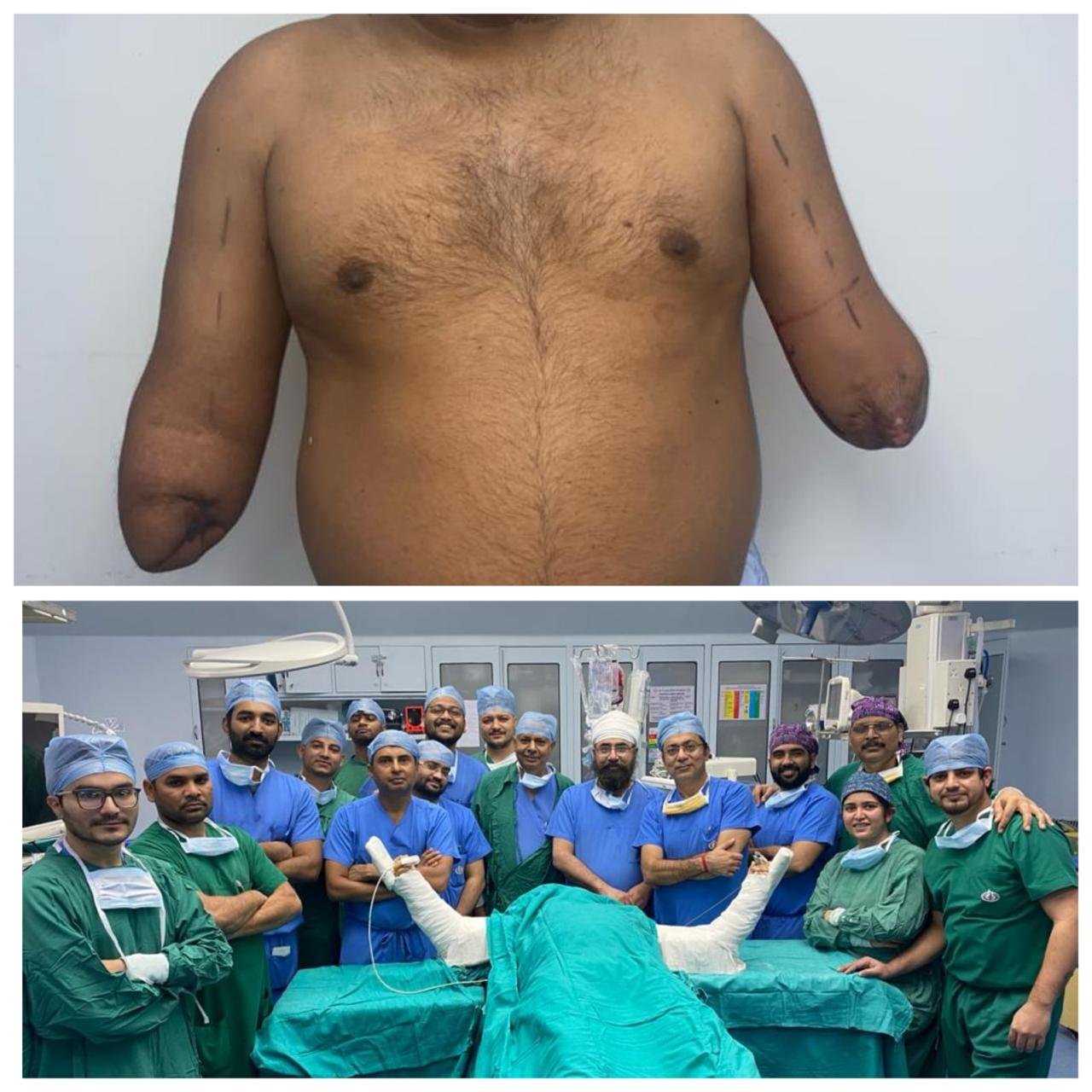
The second hand transplantation at Amrita Hospital Faridabad was conducted on a 19-year-old youth, Devansh Gupta, hailing from Delhi. He lost both upper limbs (hands) and the right lower limb above the knee in a train accident three years ago. The two hands he received in transplantation belonged to 33-year-old man from Surat who was declared brain dead due to a chronic and fatal lung condition. His family readily agreed to donate his various organs, including his hands, immediately following his death, and that is when Devansh’s prayers for a new pair of hands were answered. The hands were flown to Faridabad from Surat in a complex logistical operation.
Said Dr. Anil Murarka, Senior Consultant, Centre for Plastic & Reconstructive Surgery, Amrita Hospital Faridabad: “The patient’s right limb was transplanted at the upper arm level and the left limb just above the elbow level. The higher the level of amputation, the more challenging the hand transplant becomes, and there are profound technical issues in upper arm-level hand transplant. So far, the patient’s progress has been excellent. He needs to take immunosuppression lifelong so that the new hands are not rejected by his body. It will take him anywhere between 6 to 18 months to regain enough function in his new hands to do day-to-day activities. He also needs to undergo intensive physiotherapy including muscle stretching for another year.”
Said the patient Devansh Gupta: “When I lost both my hands at such a young age, I couldn’t come to terms with reality. It was a devastating loss from which it was impossible to recover. My life as I knew it came crashing down. Getting a new pair of hands seems like a dream come true to me. God has finally answered my prayers. I eagerly look forward to the day when I will feel the first sensation in my hands and be able to move my fingers. I thank the doctors of Amrita Hospital for giving me a new life and a new hope.”
Said Swami Nijamritananda Puri, Administrative Director, Amrita Hospital, Faridabad: “I extend my heartfelt congratulations to the Amrita doctors for achieving such a remarkable medical feat, particularly in successfully conducting a hand transplant on a kidney transplant recipient, which is India’s first. This accomplishment is a testament to the world-class infrastructure of our hospital and the exceptional skills of our surgeons. In a brief period, Amrita Hospital has emerged as one of the world’s leading institutions for hand transplants.”
Said Dr. Sanjeev Singh, Medical Director, Amrita Hospital, Faridabad: “My congratulations to Amrita doctors and everyone involved for the two successful hand transplants in Faridabad. This is a major medical feat. The hand transplant surgery posed a risk of kidney failure to the 64-year-old patient, but thanks to the entire team at Amrita, the surgery was a success. We now look forward to both the patients leading normal lives, like anyone else.”
The success of this complex operation was attributed to the concerted efforts of a multidisciplinary team. Key contributors include consultants in Plastic and Reconstructive Surgery, such as Dr. Shikha Gupta, Dr. Devajyoti Guin, Dr. Srilekha Reddy, Dr. Vasundhra Jain, and Dr. Arun Sharma. The Department of Anesthesiology, led by Dr. Mukul Kapoor and supported by Dr. Shaloo Garg, Dr. Niti Gulati, and Dr. Ketan Kulkarni, played a pivotal role in managing the patient throughout the procedure and the post-operative period. Orthopaedic surgeons, Dr. Mrinal Sharma and Dr. Priyadarshi Amit, along with their team, ensured the quick union of bones for limb stability.
In Nephrology, Dr. Zacharia Paul, Dr. Urmila Anand, and Dr. Kunal Gandhi managed crucial immunosuppression to prevent limb rejection. The Pathology Department, under the leadership of Dr. Gaurav and Dr. Arruparrna Sen Gupta, handled limb rejection diagnoses. Dr. Ansar Ul Haq and the Physical Medicine Department oversaw the patient’s rehabilitation post-transplantation, while Dr. Charu Dua looked nutrition of the patients. Silent contributors included nursing staff and OT technicians, including Ms. Shakti Khati, Ms. Rari Chandran, Ms. Sonia, Joginder, Rohitash, Virender, Neeraj, Akash, and ICU nurses Dharamender, Pradeep, Pawan, Megha, Pritika, Abbas, Nitika, Pramod, Swarnima, Nidhi, and Priyanka. Medical administration, represented by Dr. Danish, Mr. Ashwini Sarin, Ms. Nivedita, transplant manager Mr. Arjun, and Smt. Vani, played a crucial role in logistical coordination, including transportation of doctors and organs. Dr. Mohit Sharma also acknowledged the divine blessing of Amma, the institute’s founder, as the backbone of this surgical achievement.










Leave a comment